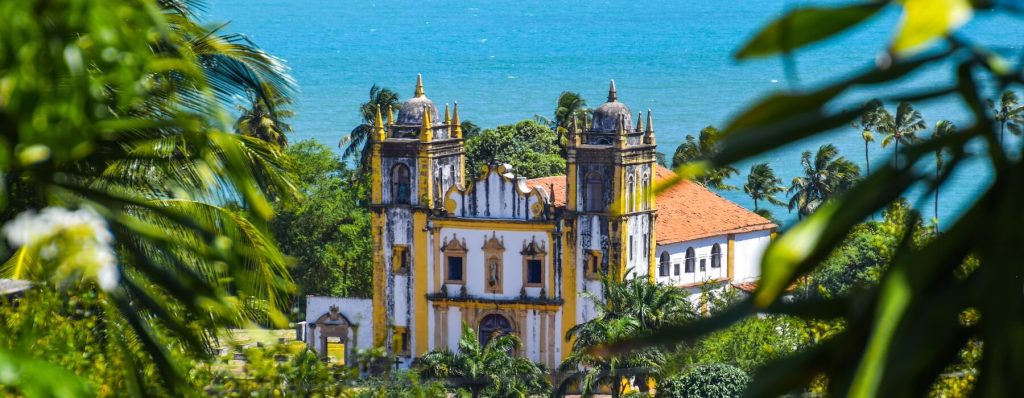

“O linda situação para uma vila,” is what Duarte Coelho Pereira, the first governor who arrived here in 1535, reportedly said. What a beautiful place for a settlement! Since then, the charming town of Olinda has been known for its stunning hilltop location overlooking the coastline in Brazil. But Olinda is more than just a scenic viewpoint. It is Brazil’s best-preserved colonial town and was declared a national monument in 1980. Stroll past pastel-colored houses, winding cobblestone streets, and baroque churches, and immerse yourself in a world full of history. Explore Brazil’s rich colonial heritage, admire the historic highlights, and be enchanted by all the beauty Olinda has to offer. In this article, we share our top tips for an unforgettable visit to Olinda.
The rich history of Olinda, Brazil: from colonial town to UNESCO World Heritage Site
Olinda is located on the coast of the Brazilian state of Pernambuco, just a few kilometers from the city of Recife. The town was officially founded on March 12, 1537. Five years later, the Portuguese brought sugarcane to the region and established the first plantations. Olinda quickly grew into a prosperous administrative and religious center of this part of the new colony, with churches, monasteries, and schools being built. However, in 1631, the Dutch abruptly ended this period of prosperity, setting the town on fire, plundering it, and leaving much of it in ruins. After the Dutch were expelled, the Portuguese rebuilt and restored Olinda.
In 1980, Olinda was designated a national monument, and in 1982 it was recognized as an ecological city of Brazil. On December 14 of that year, Olinda was declared a UNESCO World Heritage Site. Today, it is a vibrant and charming town filled with artists, artisans, and musicians. That’s why it’s featured in our article on the most beautiful places in Brazil.
1. What to do in Olinda: explore the historic center of Brazil’s colonial gem
Olinda is a city best explored on foot, letting yourself be enchanted by its unique character. Every corner and narrow alley tells a story about Olinda’s rich history and vibrant culture. The narrow streets, steep hills, and colorful houses invite you not only to explore but also to capture stunning photos!
You can still spot many of the city’s historical features, even though Olinda isn’t as well-preserved as other colonial towns in Brazil, such as Paraty and Ouro Preto. The overhead cables are unavoidable, but in our opinion, they actually add a bit of charm to Olinda.


2. Celebrate Carnival in Olinda: Brazil’s colorful festival experience
The town of Olinda is especially famous for its carnival. If you’re planning to visit Brazil during carnival season, the parade with the giant puppets in Olinda is an absolute must-see. Olinda’s carnival is very different from Rio de Janeiro. It stands out for its traditional maracatu music and parades featuring enormous puppets through the narrow, historic streets. This contrasts with Rio de Janeiro, where carnival is known for spectacular samba shows and large-scale parades, making both celebrations worth experiencing. Of course, you can only be in one place at a time—another great reason to return to Brazil!
Don’t worry if you visit Olinda at another time of year. You can still get a taste of how carnival is celebrated here. Casa dos Bonecos Gigantes is open year-round. In this museum, you can admire the impressive giant puppets up close. Each puppet is a work of art in itself, full of colorful details and rich history. Small performances are also held here, making it a fun way to experience a piece of Olinda’s carnival magic, no matter when you visit.


3. Explore the Alto da Sé Open-Air Market in Olinda
Want to buy authentic handicrafts in Olinda? Head to the Mercado Artesanato at Alto da Sé! Perched on a hill above Olinda’s historic center, this open-air market is filled with charming stalls. Here, you can find beautifully handmade items, from woven grass bags and embroidered works to unique art pieces and colorful souvenirs.
Alto da Sé is worth a visit not just for the market. From here, you’ll also enjoy the best panoramic views of Olinda. Plus, there are several charming eateries and occasionally live performances. It’s the perfect spot to fully immerse yourself in the vibrant culture of Pernambuco.
If you love trying local dishes and want to taste something typical from Brazil’s northeast, don’t miss the tapioca at Cafetaria Alto da Sé. Housed in a historic residence transformed into both a restaurant and souvenir shop, it’s famous for “grandma’s tapioca.” Tapiocas are tortilla-like flatbreads made from cassava, filled with a variety of sweet and savory ingredients—think butter, cheese, coconut, condensed milk, or beef. Absolutely delicious!


4. Admire the Cathedral of São Salvador do Mundo in Olinda
A visit to Alto da Sé isn’t complete without stopping by the Cathedral of São Salvador do Mundo, also known as the Catedral da Sé. It’s the most famous and visited architectural landmark in Olinda, and the largest 16th-century church in Brazil. This centuries-old cathedral, the second-oldest religious building in Pernambuco, is a true masterpiece. We were amazed by the stunning Renaissance and Baroque features that make this cathedral so remarkable!
5. Don’t miss the Igreja do Carmo church
Did you know that Olinda is home to no less than 20 baroque churches? The Igreja do Carmo is one of the most beautiful and impressive examples. Its stunning architecture makes it a true feast for the eyes, and the church is very well maintained. Definitely worth a visit when exploring Olinda.


6. Enjoy the views at Caixa d’Água
The Caixa d’Água is a historic water reservoir built in 1934 to improve Olinda’s water supply. Today, it houses a viewpoint offering a stunning 360-degree panoramic view over both Olinda and Recife.
To reach the Caixa d’Água, take the staircase starting at Praça do Carmo. Entrance costs just 2 Brazilian Reais.
7. Stroll through the Convento de São Francisco, one of Brazil’s oldest monasteries
The Convento de São Francisco is one of Brazil’s oldest monasteries, built in 1585. This impressive complex includes several buildings, such as a church, a chapel, a library, and a museum.
Inside, you are greeted by interiors richly decorated with azulejos (blue-and-white tiles), intricate wood carvings, and gilded details. The museum houses a remarkable collection of religious artworks, colonial furniture, and ancient books, offering a deep insight into the colonial history and culture of the region.
8. Immerse yourself in Olinda’s vibrant art scene
Art and the city of Olinda are inseparable, and you’ll find countless galleries scattered throughout town. It’s the perfect place to pick up a colorful painting or other artwork for your home.
One street you definitely shouldn’t miss is Rua do Amparo. Packed with local artists’ studios, restaurants, and boutique pousadas (B&Bs), it’s the cultural hub of Olinda. Some buildings have even swapped their original pastel colors for full street-art murals—an exciting sight to behold! Be sure to stop by the charming hotspot Bodega de Véio, a small shop that doubles as a bar. With only a few stools, you might need a bit of luck to grab a seat, but it’s the perfect spot to soak up the life of Olinda while enjoying a refreshing caipirinha.


The best and easiest way to reach Olinda
Olinda isn’t very large, which makes it possible to explore the city in just one day. It’s often visited as a day trip from Recife or the nearby beach town of Porto de Galinhas. The easiest way to reach Olinda is by flying into Recife International Airport (REC). From the airport, a taxi ride to Olinda takes about 20 minutes. There are also organized tours from both Recife and Porto de Galinhas that make visiting Olinda simple and convenient.
If you have the time to explore Olinda at a more relaxed pace, we definitely recommend spending at least one night in the city!
The best places to stay in Olinda: hotels we recommend
The colorful colonial town of Olinda is considerably calmer than its big brother, Recife. It’s a striking contrast: a picturesque, relaxed village right next to a bustling modern metropolis. With that in mind, it’s no surprise that Olinda is full of cozy and charming boutique pousadas for an overnight stay.
To fully immerse yourself in the atmosphere of Olinda, we recommend spending a night in the historic center. Accommodations we suggest include Hotel 7 Colinas, Pousada Flor de Olinda and Pousada dos Quatro Cantos. Hotel 7 Colinas is a luxury property featuring a swimming pool and a beautiful garden, with an average rate of around €100 per night. Pousada Flor de Olinda is a simple yet tidy pousada, where rates are approximately €30 per night. The third option, Pousada dos Quatro Cantos, offers a comfortable middle ground, complete with a pool and sunny terrace with garden, at around €60 per night.
Travel to Olinda during your road trip in Brazil
Olinda was definitely one of the highlights of our trip through Brazil. Are you planning a trip to Brazil but feel a bit unsure about visiting? Maybe you’re concerned about safety or haven’t yet figured out the best route. We can take those worries off your shoulders and help you every step of the way!

An unforgettable journey in Brazil
Are you dreaming of a road trip through the diverse country of Brazil? During a personal video call, we’ll map out your wishes and advise you on the most beautiful destinations that suit you perfectly. Prefer to leave everything to us? That’s possible too! As your personal travel consultants, we can organize a fully tailor-made trip. Travel carefree and request a personalized travel plan for your Brazil vacation.