Content

Nîmes is one of the most surprising and underrated cities in Southern France. It has everything you could want for a relaxed city break: a remarkably well-preserved Roman arena, beautiful gardens filled with fountains and shady pathways, charming streets made for wandering, and a lively covered market scented with fresh bread, olives, and local cheeses. In between sightseeing, settle down on a sunny terrace for a long lunch or a glass of local wine. Its laid-back charm and slightly rugged character make Nîmes a really fun city to visit. In this travel guide, we share the best things to do in Nîmes, including must-see attractions, local food spots, hidden gems, and unforgettable day trips in the surrounding region.

Visiting Nîmes: the best things to see and essential travel tips

Don’t expect Nîmes to be a city that’s only about history. Yes, the Roman landmarks are undeniably impressive, but what makes a city break in Nîmes truly special is experiencing everyday local life. Take your time to explore and the city starts to reveal itself in layers. A coffee on a sunny square, a spontaneous detour down a street that wasn’t on your plan, wandering through Les Halles market, and suddenly stumbling upon a 2,000-year-old monument just around the corner. This is the rhythm of Nîmes. We recommend spending at least two days in the city. The historic centre is compact, and almost everything is within walking distance, making it perfect for slow exploration. In this guide, you’ll find the best things to do in Nîmes, along with practical tips and highlights to help you make the most of your visit.

French people drinking coffee on the terrace
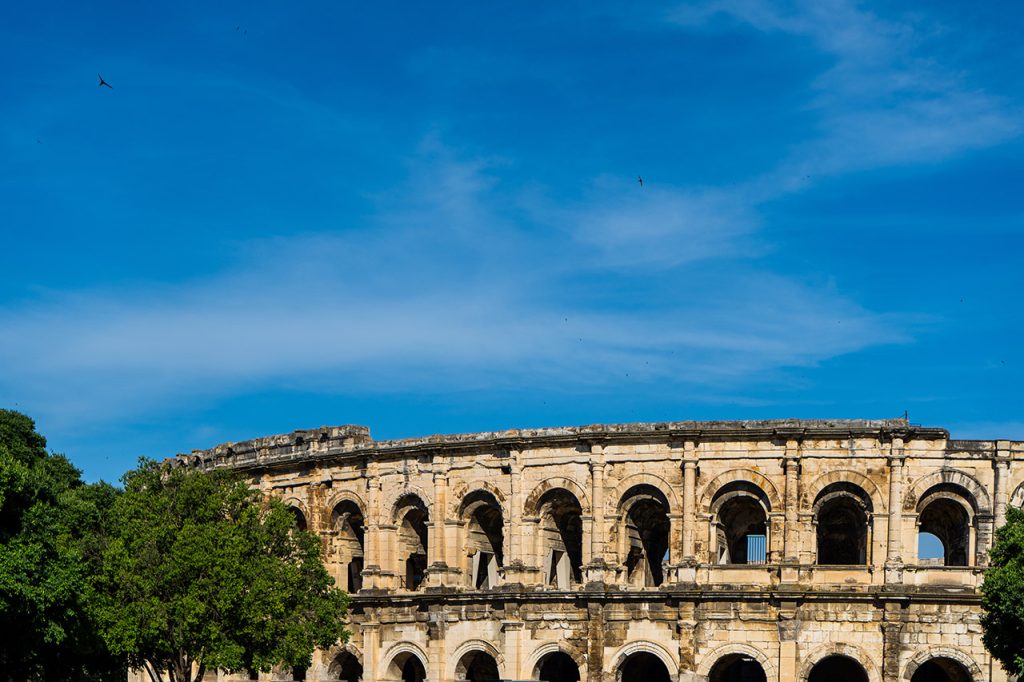
View of Nîmes’ iconic landmark: Les Arènes
Atmospheric street scene with shutters and soft evening light

1. Les Arènes de Nîmes: one of the best-preserved Roman amphitheaters in the world

There are few places in Europe where you can get this close to Roman history as you can in Nîmes. Did you know that Les Arènes de Nîmes is considered one of the best-preserved Roman amphitheaters in the world? This iconic landmark sits right in the heart of the city, surrounded by lively terraces and cafés. 

The amphitheater is more than 2,000 years old, but what really sticks with you are the numbers. Les Arènes once held up to 24,000 spectators, and the entire venue could be filled in just 10 minutes, something that feels almost unimaginable today. The games were free, and attendance was mandatory. The organizer of the events funded everything and entered the arena through the main gate, marked by the distinctive bull sculptures above the entrance. 

Another interesting detail is that the word “arena” comes from the Latin word for sand. The sand-covered floor in the centre of the amphitheater was where the fights took place, and it’s where the name originates. The sand also served a practical purpose, absorbing blood during the combats. Most fights were one-on-one, with gladiators entering the arena in different types of armor, weapons, and fighting styles, each designed to entertain and divide the crowd. They didn’t only fight each other, but also wild animals such as wolves, deer, and bears. Beneath the arena, tunnels were used to bring gladiators and animals up to the floor. While you can’t visit them today, guides often mention that excavations uncovered bones from both animals and humans.

What makes Les Arènes even more fascinating is that it wasn’t just a monument left untouched after Roman times. Up until around 200 years ago, people actually lived inside the amphitheater. Around 200 houses were built within its arches and stands, forming a small community that existed from the 14th until the 19th century. It was only later that the arena was cleared and restored to its original Roman form. Today, it once again serves as a spectacular venue for events, concerts, and shows.

View from the upper ring of Les Arènes de Nîmes over the city of Nîmes
View from the upper ring of the Arena
Visiting Les Arènes de Nîmes in Nîmes
Les Arènes from the surrounding square
Inside at Les Arènes de Nîmes
The amphitheater overlooking the 'arena'

2. Musée de la Romanité: where history comes to life

Right next to Les Arènes you’ll find the Musée de la Romanité, which opened in 2018. The building is a destination in itself, with a striking façade made of thousands of glass “scales” designed to echo the folds of a Roman toga. A visit here takes you through the full Roman history of Nîmes, from the earliest settlements to late antiquity and everything in between.

Spread across multiple floors, you’ll walk past mosaics, sculptures, everyday objects, and detailed reconstructions that bring the past to life. The museum is modern and highly interactive, making it especially engaging for children as well. Personally, what stood out most were the everyday artifacts: wine barrels, children’s toys, ceramics, and of course the beautifully preserved mosaics, which are truly impressive up close. 

Tip: head up to the rooftop terrace for one of the best views in Nîmes, overlooking Les Arènes and the city skyline. You’ll also find one of our favorite restaurants up there, making it an ideal spot to combine culture with a long, relaxed lunch or dinner.

The glass facade of the Musée de la Romanité in Nîmes, designed by Elizabeth de Portzamparc
The glass facade of the Musée de la Romanité
Roman mosaic at the Musée de la Romanité in Nîmes
Roman mosaic at the Musée de la Romanité
View from the roof terrace of the Musée de la Romanité of the Arènes and rooftops of Nîmes
The rooftop terrace overlooking Nîmes

3. Jardins de la Fontaine: a city park built around a Roman water source

If there’s one place in Nîmes where you can easily spend a few hours, it’s the Jardins de la Fontaine. This park was built around the city’s ancient sacred springs, and is often considered one of the most beautiful parks in Southern France, and in my experience, it absolutely lives up to that reputation. The gardens gently rise along the hillside, featuring symmetrical pathways, stone balustrades, fountains, and tranquil ponds. It’s the kind of place where you naturally slow down and just wander.

Within the park you’ll find the remains of the Temple of Diana, a Roman temple that has been weathered by time but is still remarkably atmospheric. At the top of the hill stands the Tour Magne, a Roman watchtower that you can climb for a panoramic view over Nîmes and the surrounding landscape. The climb is short but steep, and the reward at the top makes it more than worth the effort.

Entrance to Jardins de la Fontaine with the Tour Magne
Ruins of the Temple of Diana in the Jardins de la Fontaine in Nîmes
Ruins of the Temple of Diana
Classic stone terraces and fountains in the Jardins de la Fontaine in Nîmes
Classic stone terraces in the Jardins de la Fontaine

4. Les Halles de Nîmes: the local market full of fresh produce

Local markets say a lot about a city, and Les Halles de Nîmes is no exception. This covered market on Place des Herbes is a daily meeting point for locals, and you notice it the moment you walk in. The cheese stalls are especially busy, offering varieties you may have never heard of before, but are encouraged to taste freely. Bakeries and vegetable stalls also draw steady queues. 

Mornings are the busiest time of day, and in our opinion, also the best time to visit. Pick up a piece of cheese, ideally Pélardon, a local specialty, along with some olives and a fresh baguette for a picnic in one of the city’s parks.

The covered market Les Halles de Nîmes with fresh produce and local specialties
The indoor market Les Halles de Nîmes
Stalls selling fresh vegetables at the market in Nîmes

Other specialties you'll find at the market, or in Nîmes, are:

  • Brandade de Nîmes: this is the city’s signature dish: a creamy purée made from salted cod, olive oil, and garlic.

  • Gardiane de taureau: a slow-cooked stew made with Camargue bull meat, olives, herbs, and red wine.

  • Picholine olives: the local olive from Gard, soft and slightly nutty.

  • Pélardon: soft goat cheese from the nearby Cévennes.

  • Costières de Nîmes: the local wine, with reds on Grenache and Syrah and fresh rosés.

Fresh Picholine olives at the market in Nîmes, the local olive from Gard
Fresh Picholine olives at the market in Nîmes
Pélardon, the soft goat cheese from the Cévennes, for sale at the market in Nîmes
Pélardon, the soft goat cheese from the Cévennes
The salted cod for Brandade de Nîmes

5. Les Ateliers de Nîmes: the story behind authenic denim

Few people know that denim actually owes its name to Nîmes. The fabric, originally called “serge de Nîmes,” was woven here centuries ago and exported all over the world. That legacy is still very much alive at Les Ateliers de Nîmes, a workshop and boutique in the heart of the city dedicated entirely to artisanal denim.

Here, jeans are hand-finished, repaired, and tailored with great attention to detail. The quality is exceptional, making a purchase here something truly special rather than just another souvenir.

If you want to dive even deeper into the story of denim, the Musée du Vieux Nîmes (located in the former episcopal palace near the cathedral) features an entire section dedicated to the city’s textile history, including the origins of denim. It’s a great cultural addition to your visit to Les Ateliers.

Artisanal denim from Les Ateliers de Nîmes, the place where the fabric got its name
Crafted denim from Les Ateliers de Nîmes
The exterior of the Musée du Vieux Nîmes in the former bishop's palace
The exterior of the Musée du Vieux Nîmes
Exhibition on the history of denim at the Musée du Vieux Nîmes
Exhibition on the history of denim

6. Richelieu and Gambetta: creative neighborhoods full of street art

Richelieu and Gambetta are two of the newer neighborhoods in Nîmes, built right up against the historic city center. They feel different from the old town: less polished, more raw, with apartment buildings and streets where everyday life feels a bit more lived-in. But it’s exactly here that you discover one of the most unexpected and moving sides of Nîmes.

Residents decided to bring color to their surroundings, partly funded by the community itself. The façades of residential buildings were transformed with street art created by both local and national artists; a grassroots initiative that started from the neighborhood itself. The city embraced the project and now hosts an annual festival that continues to add new works. Today, the area is home to around 160 murals. Each piece tells its own story. Some are politically charged, others focus on fantasy, identity, or local history. It’s absolutely worth wandering through these neighborhoods and letting yourself be surprised by the variety and creativity on display.

One of more than 160 murals that color the Richelieu and Gambetta neighborhoods in Nîmes
A typical work of art in Gambetta
Colorful mural on a facade in Nîmes
A colorful mural by a local artist
Street art in the Gambetta neighborhood of Nîmes
A nice vista of street art in Gambetta

Where to stay in Nîmes: these are our tips

The center of Nîmes is compact, so a hotel near the Arènes or the Place de la Maison Carrée gives you an immediate base. I myself stayed at Appart'City Collection Nîmes Arènes and that was a very fine choice. 

The apartments are spacious and well equipped, with a kitchenette that gives you the freedom to prepare your own meals. Especially nice if you’ve picked up local products from Les Halles. Breakfast is also available at the hotel, and the location is arguably its biggest advantage: you can walk to Les Arènes in just a few minutes. The beds are comfortable, making it an easy and restful place to recharge after a day of exploring the city.

Appart'City Collection Nîmes Arènes

Nîmes
  •  

More nice hotels in Nîmes

Nîmes
  •  

How to get to Nîmes?

Nîmes is located in the south of France and is well connected by high-speed rail, making it an easy destination to reach from many major European cities. The most comfortable way to travel is by train. Depending on your starting point, you can connect to France’s TGV network via cities such as Paris, Lyon, or Barcelona. From Paris, for example, you can take a direct TGV high-speed train to Nîmes or nearby Avignon and Pont du Gard. The journey typically takes around 3 to 5 hours on the high-speed section. 

From cities like Brussels, London, Amsterdam, or Frankfurt, you can travel to Paris or Lyon first, and then continue south on the TGV. Total travel time is usually around 6 to 10 hours, depending on your connection. Train travel is, in our opinion, one of the most relaxed ways to reach the south of France. You have plenty of space, scenic views along the way, and your trip already feels like part of the holiday experience.

My tip for transferring in Paris: When planning your journey, always allow enough transfer time between train stations in major hubs like Paris or Lyon. A minimum of 1 hour is recommended, but 2 hours is safer and more comfortable.

Buy your tickets for the train journey to Nîmes here

Where to eat in Nîmes: the best restaurants

The cuisine of Nîmes reflects the broader Languedoc and Provence regions: rich stews, fresh vegetables, olive oil, grilled fish, and flavorful meats. One of the city’s most iconic dishes is brandade de morue, a creamy purée made from salted cod, olive oil, and garlic. You’ll also find excellent olives, local rosé wines, and cheeses from the market that are simply irresistible. If you’re looking for great places to eat and drink in Nîmes, here are some of our favorite restaurants.

7. GAMEL restaurant

Just outside the city center, tucked away on a quiet square where mostly locals gather, you’ll find GAMEL. This small restaurant has a cozy terrace next to a fountain, creating a relaxed and intimate atmosphere. The menu is only available in French, but the friendly staff are happy to help translate into English. The menu is intentionally small, which is part of its charm. Dishes change with the seasons and what’s available at the market, ensuring everything is fresh and local. You can choose à la carte or go for a set menu. I opted for a vegetarian main course followed by an incredible chocolate dessert. Every dish was full of flavor and beautifully balanced, a true highlight of the evening.

Gamel restaurant in Nîmes, eating out, little square with fountain
The atmospheric terrace of Gamel
Vegetarian restaurant Gamel in Nîmes, eating out, restaurant tip
Vegetarian main course full of flavors
The chocolate dessert at GAMEL restaurant in Nîmes
The delicious chocolate dessert

9. L'Accent Bistrot Chic

Behind L’Accent lies a story you won’t forget. The Dutch owner moved to Nîmes ten years ago, not for love of a person, but for her love of the city itself. She worked for different employers to learn the language and understand the craft, before eventually opening L’Accent. The restaurant has now been established for over 3.5 years, and its success recently led to the opening of a second location. And that success is something you can taste on the plate. The cuisine is classic French with a contemporary twist: refined, thoughtful, and full of attention to detail. The interior is warm and inviting, making it a wonderful place for a relaxed lunch or dinner in Nîmes.

Have lunch at L'Accent Bistrot Chic in Nîmes.
L'Accent Bistrot Chic in Nîmes
Delicious dish from the menu: ceviche!

10. La Table du 2

La Table du 2 is the place to go if you’re looking for a special evening in Nîmes. The restaurant is located on the top floor of the Musée de la Romanité, one of the city’s key attractions mentioned earlier in this guide. Dining here comes with a major highlight: the incredible view. From the terrace, you’ll overlook the impressive Les Arènes, beautifully lit and framed by the city skyline. If you have time, make sure to also visit the museum’s rooftop terrace. It’s especially magical in the evening, when the low sun casts a warm glow over the city. At that moment, the view over Nîmes becomes truly unforgettable.

The menu is extensive yet carefully curated, featuring both classic dishes and more surprising creations. Every plate reflects a clear passion for cooking, which is exactly what makes a dinner here so enjoyable. This is not the kind of place for a quick bite, but rather a restaurant designed for long, relaxed evenings at the table, where you take your time and truly enjoy the experience. 

My favorite: artichoke bruschetta
Dining out at La Table du 2 in Nîmes overlooking Arènes
Dining at La Table du 2 overlooking Arènes
A delicious mocktail at La Table du 2 restaurant in Nîmes
Cheers to an evening of dining in Nîmes

11. Dine in an elegant setting at Café Fragonard

If you’re looking for an intimate, exclusive setting for dinner in Nîmes, Café Fragonard is the place to book. The restaurant is located in a beautiful historic townhouse that now forms part of a luxury five-star hotel (Margaret - Hôtel Chouleur in Nîmes). The high-end atmosphere is reflected in every detail: the service is excellent, and the entire setting exudes elegance. 

The cozy inner courtyard is where you can dine outdoors, and with only ten tables, the intimate and exclusive atmosphere is immediately clear. 

The menu changes seasonally, offering either a refined two- or three-course set menu or à la carte dining. During my visit, the baked zucchini with cheese was an absolute standout, and the meringue dessert with pistachio and rhubarb was the perfect finishing touch.

Dinner out at Cafe Fragonard with main course of zucchini and cheese
My main course: fried zucchini with cheese
The elegant courtyard of Café Fragonard
The delicious meringue dessert over dinner at Cafe Fragonard in Nîmes
The delicious meringue dessert

Fun day trips from Nîmes

Nîmes is a fantastic base for exploring some of the most beautiful places in the region. Renting a car is a great option if you want the freedom to discover the surrounding countryside at your own pace. The area truly rewards you for it.

12. Pont Du Gard

About 30 kilometers from Nîmes, you’ll find one of the most impressive structures in Southern France: the Pont du Gard. This Roman aqueduct, nearly 2,000 years old, rises three levels high and towers 50 meters above the Gardon River. It’s a UNESCO World Heritage Site, and the moment you see it in person, it’s easy to understand why. 

What makes this place so special is not only the scale of the aqueduct itself, but also its stunning natural setting. It sits in the middle of the garrigue, a typical Provençal landscape of dry, fragrant vegetation. Below it, the river is crystal clear in summer, with deep green tones that invite locals to swim, kayak, or relax on the rocks along the shore. 

My tip: Plan to visit in the morning if you can. It gets hotter and more crowded later in the day. Take your time walking across the bridge, visit the visitor center, and then cool off in the river. Afterward, settle in at Restaurant Les Terrasses for a refreshing lunch. The chocolate mousse here is often considered one of the best in the region.

The river Gardon running under the Pont Du Gard
The Gardon River where locals swim and kayak
The impressive UNESCO site Pont du Gard near Nîmes
The impressive UNESCO site Pont du Gard

13. The Roman tunnels of Sernhac

While the Pont du Gard is the absolute highlight, the aqueduct actually tells a much larger story. Over 2,000 years ago, the Romans faced a major challenge in this region: the growing population needed a reliable source of clean drinking water. They eventually found it near Uzès, at the Source de l’Eure, located at an elevation of 76 meters.

To transport the water all the way to Nîmes, they built an enormous 50-kilometer-long aqueduct. Because the elevation difference between the source and the city was minimal, precision engineering was essential. The water dropped on average just 35 centimeters per kilometer. 

But just as impressive—and far less well-known—are the Roman tunnels of Sernhac. Here, the water did not flow over a bridge; instead, due to the terrain, it had to be channeled directly through Mount Perrotte. The Romans dug shafts into the limestone every 20 meters to create underground passages, including the Perrotte and Cantarella tunnels. From here, the water then flowed mostly underground to Nîmes.

Today, you can explore this area on beautiful hiking trails, with three marked routes available. We chose the l’Eau trail, which focuses on the water system and takes you directly through the tunnels. Along the way, you can still clearly see the marks of Roman craftsmanship carved into the stone walls.

Walking through the Roman tunnels of Sernhac
Walking through the tunnels in Sernhac
The beautiful area near Sernhac where you can hike around Mount Perrotte

14. Wine tasting at Domaine de Poulvarel

Just outside Nîmes, near Sernhac and the iconic Pont du Gard, you’ll find Domaine de Poulvarel. This beautiful family-run estate is where wine and Roman history come together in a unique way. The winery is located in the hills of the Costières de Nîmes, an appellation that has significantly improved in quality over recent decades. Here, they produce characterful wines from the Rhône Valley, including AOC Costières de Nîmes and IGP Coteaux du Pont du Gard. In the vineyards, you’ll find classic regional grape varieties such as Syrah and Grenache. 

What makes a visit—and tasting—here especially interesting is the story behind the bottles. The family has a strong connection to the nearby Roman tunnels, and two of their cuvées are even named after them: Cuvée Perrottes and Cuvée Cantarelles. It’s one of those rare places where you can quite literally taste the history of the region in your glass.

A visit to wine estate Domaine de Poulvarel as a getaway from Nîmes
A visit to Domaine de Poulvarel
A wine tasting inside the wine estate
Tasting local wines at Domaine de Poulvarel
The white wine of the Costières de Nîmes label

More inspiration for your trip to France

Did your trip to Nîmes leave you wanting more, and would you like to discover what else this beautiful country has to offer? We’ve fallen in love with France and have written countless articles full of tips—from the sunny southern coast to the rugged Alps and the best city breaks.

Explore the sunny French Riviera and the impressive mountain regions

If you want to stay in the south after visiting Nîmes, or head further into the mountains, these guides are a great next step: 

Escape to the Opal Coast

If you prefer staying closer to home while still enjoying that classic French feeling, northern France might surprise you. These guides are perfect for inspiration:

Romance in and around Paris

Paris is the ultimate classic city break, but there’s even more to discover just outside the capital:

customized travel proposal - Travander

Tailor-made dream trip to France

Feeling inspired to head to the French sun after reading all these tips, but not looking forward to hours of planning? Whether you’re dreaming of a culture-filled city break in Nîmes, a relaxed road trip along vineyards in the south, or an unforgettable journey through the French Alps, we’re happy to take care of everything for you. As travel specialists, we know the best small-scale stays and carefully design routes that make sense from start to finish, optionally even fully sustainable by train. We create a unique trip tailored to your wishes. All you have to do is pack your bags and enjoy the journey.

Share this post:

Picture of Lois Weeterings

Lois Weeterings

A dreamer and adventure seeker, always on the lookout for new experiences. But also a hard worker with a thousand ideas racing through my mind. As a personal travel consultant and travel blogger, I share my passion for faraway destinations, thrilling adventures, and winter sports. With deep knowledge of places like Namibia, Colombia, the ABC Islands, and the Middle East, I’m here to help you craft a trip you’ll never forget. Through my personal stories and expert tips, I aim to inspire you to explore the world your way. Always with my camera in hand, I’m determined to capture every magical moment and share it with you.